Monday, 11 January 2010

The Problems We Faced Filming

"It's not important to me that people understand me."
-Kate Bush


Filming the music video completely scrapped any predictions Lana and I had made, and we found difficulties and benefits in areas we did not expect to face.

Firstly, the weather proved to be a notable issue. Our model, Daniella Gordenfelt, was required to wear a revealing outfit to maintain our electro-pop image. The night we filmed was particularly cold, and there was also light rain-which proved to be a hassle in terms of her hair, make-up and health. This lead to time constraints, and for the sake of her welfare, we took Daniella in and out of my house between filming each scene.
A picture of Daniella in her outfit:


We also had the issue of taking care of the equipment in the outdoor conditions. We held an umbrella over the camera equipment at all times, and luckily the rain nor the wind was strong enough to touch or damage the camera.
A picture of how we filmed:


Another factor that proved to be an issue was the lighting on the camera. Due to the damp weather and cloudy skies, the area was very dark-thus we had to experiment with the camera's settings to be able to capture visible footage. We discovered that on the side of the camera, hidden under a panel, is a dial that allowed us to change the brightness of the camera. The brightness ended up effecting the color of the image, converting to a pink/red color. This proved to beneficial, as red is a color that we intend to keep consistent in the artist, Ultra Violet's, image-along with the color purple.

Another issue we faced in filming was the height of the equipment, and the height of the shots we intended to film. Lana had an issue with reaching the camera throughout all of the outdoor shots, which resulted in me filming all of them. Lana, however, filmed most of the shots in my house, of Daniella in her chair, and on the sofa.

There were also issues with illness. For the concert sequences that took place in my school's theatre, Lana was ill on our scheduled date, and due to time constraints, it resulted in me filming all of the shots, as well as compiling the other shots I filmed for the concert projection myself. I also hired a lighting technician, whom failed to show.

I had great difficulty filming as well as arranging the actors and equipment, all of which consisted of having to get the actors themselves to control lighting, and having to arrange with the school's staff for my male actor, Jonathan Cobbing, to enter the school-as he is not a student, whilst Daniella is. Whilst this was a difficult task, it proved to be successful, and I feel rewarded by the sense of independence I needed to develop at the very last minute.

Lana and I also faced many artistic differences, as well as Lana facing a block on ideas for the video. This lead to me having to create and film shots such as the red cone shot and the large white needle glasses shot, whilst Lana dealt with taking pictures for our blogs, as well as holding lights and so on.
A picture of us working:

Friday, 8 January 2010

Risk Assessment

"Poor is the man who's pleasures depend on the permission of another."
-Madonna


Filming In Studio:


Filming in Outside Park Areas:


Filming in Theatre:


Filming in Changing Rooms:


Thursday, 7 January 2010

Researching Film Locations

"I understand it's my role to realise people's dreams."
-Ayumi Hamasaki

Here are pictures I took as research for our video:


All of the images share a consistent similarity: the essence of domesticity, the 'local' feeling. This aligns with our desired theme of alternative fashion being casually present in modern society, that we discovered through Róisín Murphy-'attacking' the mainstream. Using these locations, if we film our model in our desired alternative clothing, a clear contrast will be present-the alternative/futuristic person amongst typical surroundings.

Tuesday, 5 January 2010

Storyboarding

"I don't like defining myself. I just am."
-Britney Spears

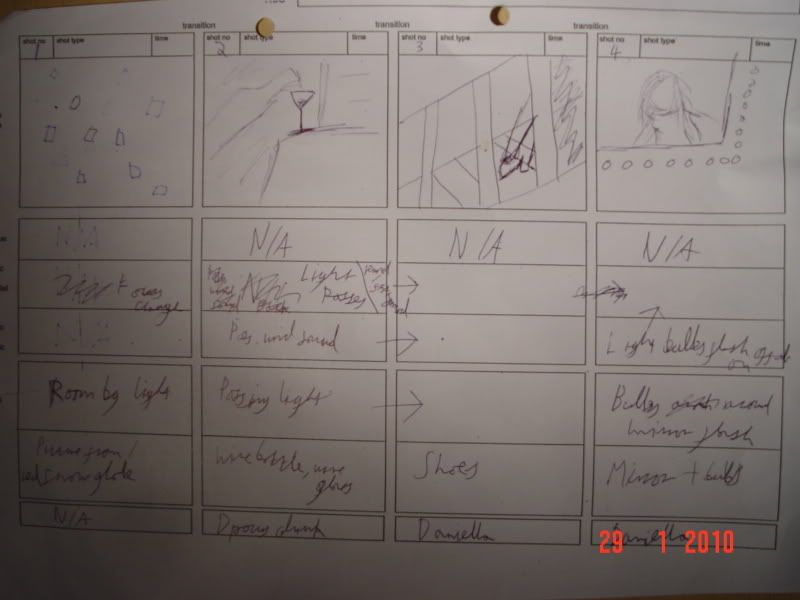
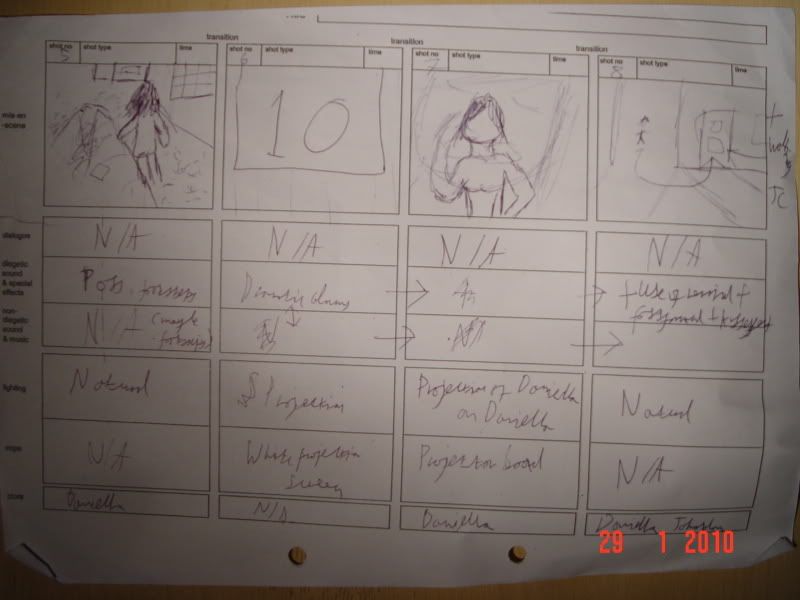
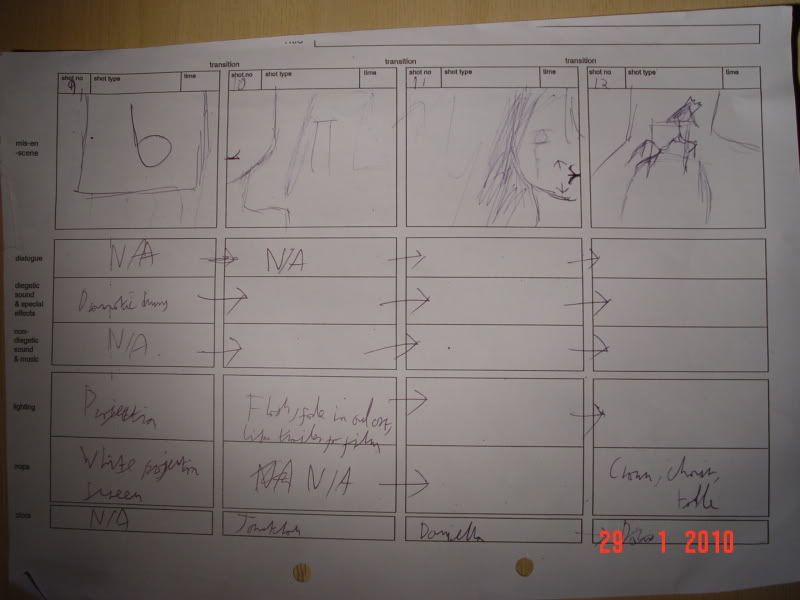
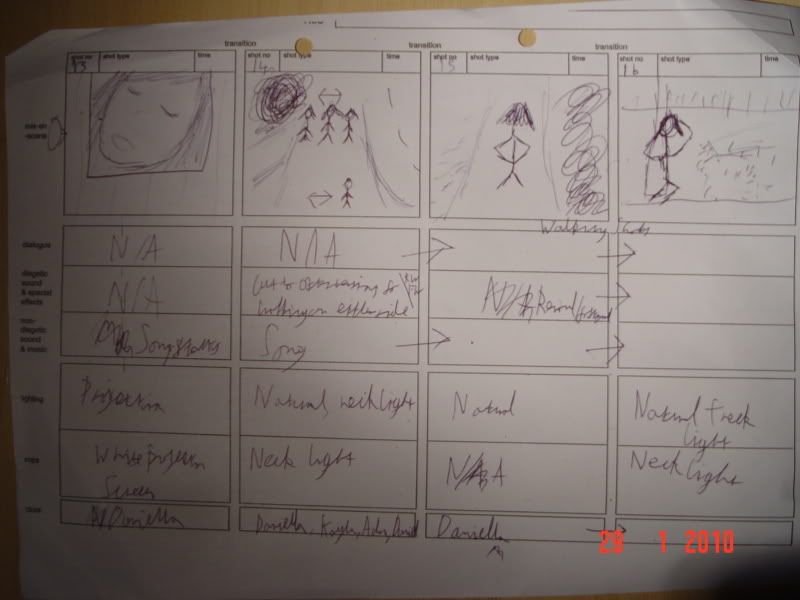
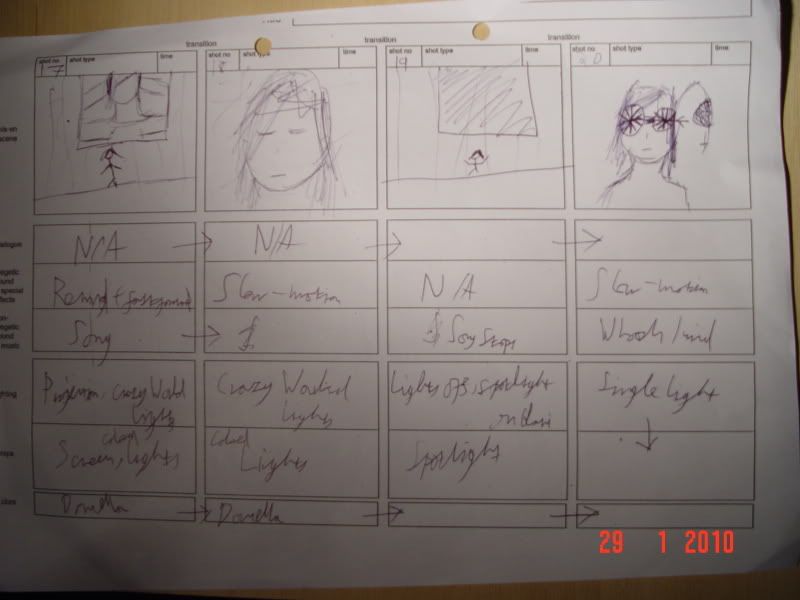
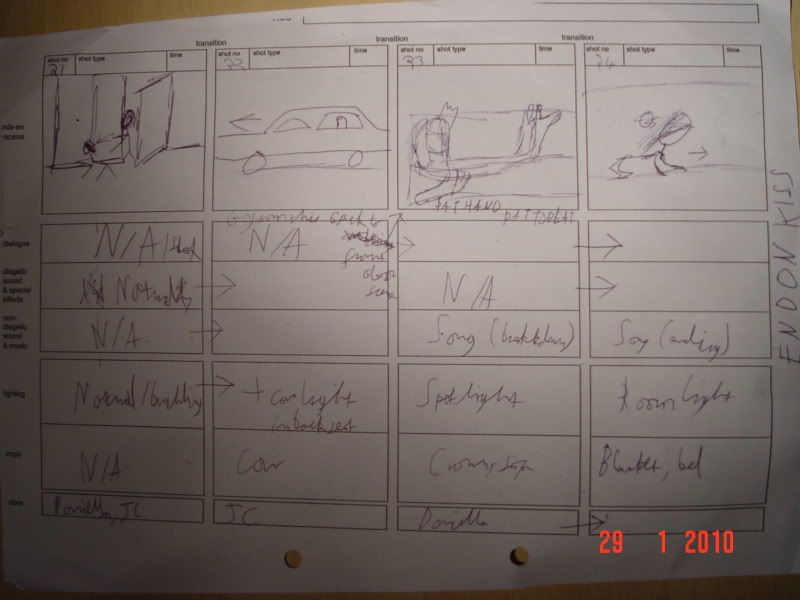
As part of our course and out of general convenience, we were required to make a storyboard to plan our film. Whilst the filming highly differed from what we originally intended within the storyboard, it still acted as the foundation of our story, our ideas, and the images presented within the film:


Monday, 21 December 2009

Miss Independent

"Everybody is doing the same old thing."
-Missy Elliot


As part of our research, I decided to look into how the model/singer should present herself, and how she should act. I looked into how female pop acts have developed over the last 30 years, and how I should present Ultra Violet to meet the needs of the mainstream at present. Perfect Circle is a song detailing the singer's reaction to a failed relationship, so the actress could either present herself as sad or angry, or uncaring-or even happy.

Firstly, I looked into women in pop in the 80s/90s. I found it particularly common for women to gain success with ballads, but most notably ballads detailing the artist's sadness towards the subject matter, or emphasising the position of the man in the relationship. An example is the 1993 hit, Mariah Carey's 'Hero':


This tradition carried on into the late 90s, with leading pop acts such as Britney Spears presenting a feminine 'weakness':


But now, we are in an era of confident women, where women take control and are powerful-the era of 'Miss Independent'. Women in mainstream pop, and mostly in electro-pop, now present themselves aggressively, and the important 'fierce' factor can be seen throughout recent releases. For example, in the video for 'Sometimes' above, Britney sings 'sometimes I run, sometimes I hide, sometimes I'm scared of you'. This shows a predictable female sensitivity. 10 years later, the artist Rihanna, whom is now in a similar scale of popularity to Spears, is now singing and acting the complete opposite:


Other leading artists such as Lady GaGa and Madonna as well as Britney Spears have also entered this aggressive stage, and the mainstream has taken this image under its wing. Thus, it inspired my ideas and intentions for the video, and with Lana's approval, we agreed that the artist, Ultra Violet, should be presented as a strong, aggressive woman.

Thursday, 17 December 2009

Selecting Our Actors

"I say its a girl's world."
-Nelly Furtado


Ultra Violet
Actress: Daniella Gordenfelt
Why: We chose Daniella because of her classic good looks, and previous experience in acting. With a fantastic facial composition, gorgeous hair, a beautiful body and an air of class, selling her image to a mass audience will be easy. As explained in Laura Mulvey's 'Visual Pleasure and Narrative Cinema', the Male Gaze is 'determining', and women 'connote to-be-looked-at-ness'. Daniella fits into this idea, with her conventional beauty easily noticeable by men.

Unnamed Male Antagonist
Actor: Jonathan Cobbing
Why: Our immediate intentions whilst finding a male actor for the antagonist were two things-a male with a look that doesn't break from a traditional man's appearance, and the ability to appear sinister. Jonathan, with his short hair cut and well-built body, fit into the role of a traditional male perfectly. We chose to have him look traditional and 'regular' so that he would not alter the focus of the video away from Ultra Violet. To meet the needs of the sinister appearance, Jonathan has an angular jaw and accentuated eyes, which give him a mischievous appearance that we found to be very appropriate. These features were necessary to meet our requirements of the antagonist's ability to appear as a negative character in the plot.

Saturday, 12 December 2009

Analysis Of Music Video

"Life is full of risks, why not take them?"
-Lindsay Lohan


To help with my research into how to present a theory and a concept in our music video, I decided to write an essay and analyse a music video that inspired me. I later submitted this essay to universities, and met very positive reviews. Below is the music video in question, and beneath that is the analytical essay.


Lady GaGa 'Telephone' Music Video Analysis

Lady GaGa is, to me and to the public, more than just a pop singer. Lady GaGa interests me far beyond the boundaries of her music. She acts as a beacon of artistic inspiration and pop culture, in all major aspects of the media: fashion, television and art. In her latest music video, 'Telephone', GaGa truly amplifies all of these aspects, as a way of both reaching to society as well as to her fans.

Throughout the video, GaGa's level of intellect becomes apparent, and a clear homage to American society begins to unfold. From the beginning of the video, a string of stereotypes appear. From the opening scene within an urban prison, the viewer can see that the female cell mates are all sexually-infused young women. As GaGa takes to the outdoors partition of the complex, the presumed stereotype of homosexual interactions between women is presented, as GaGa is seduced by another woman.

The references to American society do not stop there. Throughout the video, modern culture is presented everywhere - mostly through the medium of product placements. Virgin phones, Diet Coke hairpieces, Plenty of Fish dating websites, Polaroid cameras, Miracle Whip mayonnaise and more all represent the commercial context that is truly groundbreaking. The video may appear as sadomasochistic, or as a promotion of murder, but the depth of its hype and its avant-garde potential, I believe, stem from the drastic presentation of American media and its attitudes towards commercialism, overproduction and homosexuality. As Lady GaGa mentioned in a recent interview, '(the video) has one foot in the art community, and one foot in the commercial world.'

I took great interest in the exhibition of modern American media shown in the video due to research I made towards my portfolio, in regards to Andy Warhol. Similarly, whilst GaGa presented elements of social awareness and pop culture in the 'Telephone' video, Warhol invested his art deeply into explaining his feelings towards typical Western society. A most notable example would be his first major release, the piece 'Campbell's Soup Cans'. Much like 'Telephone', the painting celebrated modern culture, and its ability to overproduce and over-consume.

The 'Telephone' video presented a thematic study of the artistic side of everyday life, which remains rarely seen in the repertoire of music video history.